Take the gi off and Jiu-Jitsu changes fast. The collar and sleeve grips that slow everything down are gone, sweat makes every limb slippery, and the pace jumps. Some techniques carry over untouched, some need a new grip, and a few only really work without the uniform. This guide covers the no gi jiu jitsu techniques that hold up when there is nothing to grab: the ties that replace your grips, the guards and passes that still work, and the submissions that become more dangerous, not less.
At GMA in Gallatin, TN, this is the material we cover in our No-Gi grappling classes. This article explains what each technique is and when it is used. It is not a substitute for coaching. Learn every submission under a qualified coach, apply it slowly in training, and tap early.
What Changes When You Take Away the Gi
In the gi, a good grip on a collar or sleeve lets you control a much stronger opponent and hold a position for as long as you want. Without the gi, that control has to come from somewhere else: your arms around their body, their head and their wrists. Three things follow from that.
- The game gets faster. With less friction, people escape positions that would be locked down in the gi. Scrambles happen more often and they decide more rounds.
- Position is harder to hold. You hold position with pressure, angles and connection instead of fabric. Holding mount or side control in No-Gi is a skill of its own.
- Some submissions get better and some get worse. Collar chokes disappear completely. Head and arm chokes, the guillotine and leg attacks become much more common.
None of this means No-Gi is a different art. The fundamentals (posture, base, frames, hip movement, position before submission) are exactly the same. What changes is how you connect to your partner.
The Grips and Ties That Replace the Gi
Every good No-Gi player builds their game on a handful of ties. These are the No-Gi equivalent of collar and sleeve grips, and most no gi jiu jitsu techniques start from one of them.
- Collar tie. A hand behind the opponent's head or neck. It controls posture, sets up snap-downs and opens the arm drag.
- Underhook. Your arm under their armpit, hand on their back. Whoever wins the underhook usually wins the exchange, standing or on the ground.
- Overhook (whizzer). Your arm over theirs, clamping it to your side. It is the main defense against an underhook and a setup for throws and the omoplata.
- Two-on-one. Both of your hands on one of their arms. It controls a wrist or elbow and leads to arm drags and back takes.
- Wrist control. Simply holding the wrists stops a lot of attacks before they start, especially from guard.
- Body lock. Hands locked around the waist or chest. It is the base of the body lock pass and of mat returns.
- Seatbelt. One arm over the shoulder and one under the armpit from behind. It is the grip that holds back control.
Standing: Takedowns and the Front Headlock
Because nobody is gripping fabric, No-Gi matches usually start closer to a wrestling match. That is why wrestlers tend to feel at home quickly. The standing techniques that matter most:
Single leg and double leg
The two basic shots. A level change (dropping your hips, not your head) gets you under the opponent's arms, then you attack one leg or both. In No-Gi they work well because there are no sleeve grips to stop you from changing levels.
Snap-down to front headlock
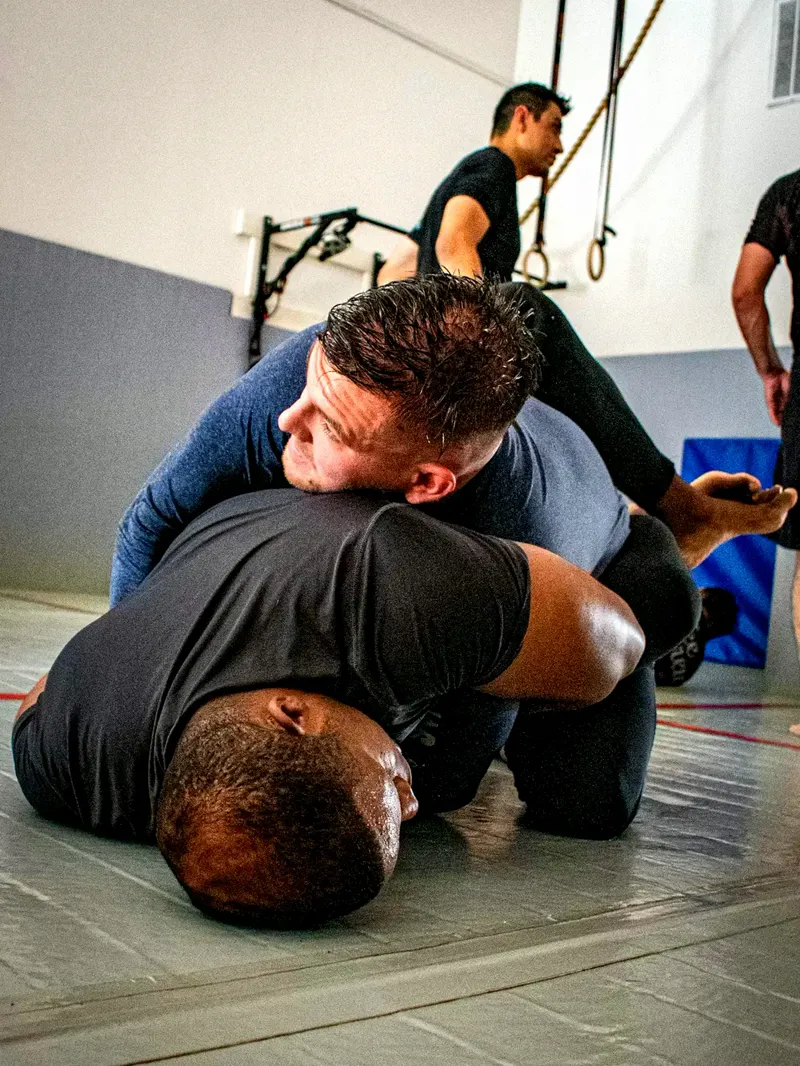
From a collar tie, you pull the opponent's head down so their hands hit the mat or they bend forward. You are now in a front headlock, chest over their head and shoulders. This is one of the most important positions in No-Gi. From it you can spin behind for the back, go to a takedown, or attack the guillotine, darce and anaconda chokes.
Arm drag
Pull the opponent's arm across their body with a two-on-one and step to their side. Standing, it opens a single leg or a back take. From seated guard, it is one of the best ways to get behind someone who does not have a collar for you to grab.
Guard Without Grips
Gi guards such as spider guard and lasso guard depend on sleeve and pant grips, so they mostly disappear in No-Gi. The guards that remain work by controlling the legs, the head and the arms:
- Closed guard. Still useful, but harder to keep closed against a sweaty opponent. Control the head and an arm (an overhook or a wrist) to break their posture.
- Butterfly guard. Your feet hooked inside their thighs while you sit up with an underhook or a two-on-one. It is the base for elevating sweeps and leg entries.
- Seated guard with a collar tie. Sitting up, one hand on the head and one on a wrist. It sets up arm drags, snap-downs and wrestle-ups (coming up to your knees to take a single leg).
- Single leg X and shin-to-shin. Guards that attack one leg, used to sweep, to stand up, or to enter leg locks.
- Half guard. The underhook from bottom half guard is one of the most reliable sweep setups in grappling, gi or not.
The bigger shift is the mindset. In No-Gi, guard players often sit up and wrestle rather than lie back and wait, because a flat guard player without grips is easier to pass.
Passing the Guard in No-Gi
Passing in the gi is often slow and grip-heavy. No-Gi passing leans on two approaches: speed and tight connection.
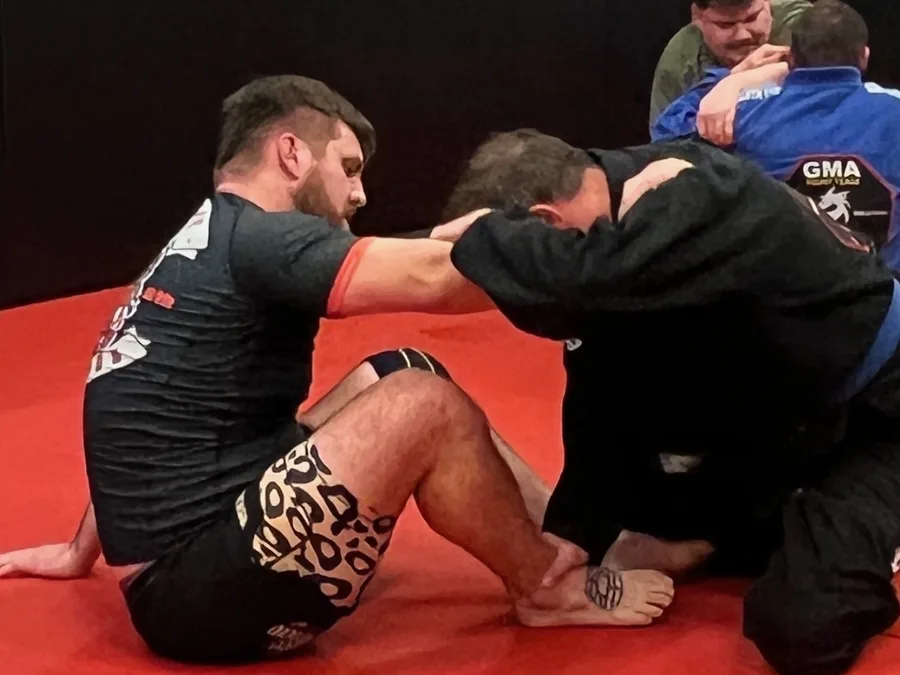
- Body lock pass. Lock your hands around the opponent's hips, stay chest to chest and walk around their legs. It is one of the most reliable passes without grips because it takes away their hip movement.
- Knee cut (knee slice). Drive your knee across their thigh to the mat while controlling the underhook and the head. Win the underhook first or you get swept.
- Leg drag and speed passes. Moving the legs to one side and getting around them before the opponent can frame. These work well when the guard player has nothing to hold on to.
Whatever pass you use, the finish is the same: chest connected, head control, and no space for their knee to come back in.
Submissions That Shine in No-Gi
Without collars, the choke game shifts to arm and head chokes. These are the submissions you will see most often (our guide to every major type of choke covers each in more detail):
- Guillotine. An arm around the neck from the front. It punishes careless takedowns and comes from the front headlock, from guard and from scrambles.
- Darce and anaconda. Arm-in chokes from the front headlock. The difference is the direction you thread your arm and the way you roll.
- Arm triangle. Head and arm trapped together, usually finished from side control or mount.
- Rear naked choke. The classic finish from back control, and the best reason to learn the seatbelt.
- Kimura. A figure-four on the arm that works from almost everywhere, and doubles as a control grip for sweeps and back takes.
- Leg locks. Straight foot locks, kneebars and heel hooks. Heel hooks are where No-Gi rules differ most from the gi: under IBJJF rules they are illegal in the gi at every belt and legal in No-Gi only for adult brown and black belts. See our article on BJJ leg locks and what's legal before you go near one.
Back Control: The Strongest Position Without a Gi
Back control is valuable in every form of Jiu-Jitsu, but in No-Gi it is often the position that ends the round. Without a collar to choke with, almost every finish from the back is the rear naked choke, so the fight is about hands. The attacker holds the seatbelt, keeps their chest tight to the opponent's back and hand-fights to clear the neck. The defender's job is to protect the neck with both hands and turn their shoulders to the mat.
Hooks (your heels inside their thighs) or a body triangle (your legs locked around their waist) keep the opponent from turning in. Because there is less friction to hold on with, staying on the back without a gi is mostly about chest connection and following the opponent's hips as they move.
Quick Reference: No Gi Jiu Jitsu Techniques by Position
| Position | Key grips | Techniques to learn first |
|---|---|---|
| Standing | Collar tie, underhook, two-on-one | Single leg, double leg, snap-down, arm drag |
| Front headlock | Chin strap, arm control | Spin to the back, guillotine, darce, anaconda |
| Guard (bottom) | Wrist control, overhook, underhook | Butterfly sweeps, arm drag, half guard underhook sweep |
| Passing (top) | Body lock, underhook, head control | Body lock pass, knee cut, leg drag |
| Back control | Seatbelt, hooks or body triangle | Hand fighting, rear naked choke |
How to Practice No-Gi at GMA in Gallatin
The best way to learn these techniques is in a structured class with live rounds at the end, then more repetitions on your own time. At GMA, Open Grappling runs Monday and Wednesday evenings at 7:00 PM for adults and teens 14 and up. The curriculum covers takedowns and wrestling, clinch control, guard retention without grips, submission chains, leg entanglements taught safely and progressively, and scrambles.
For extra reps, our weekday Open Mat runs 11:00 AM to 1:00 PM. Bring the one technique you are working on, find a partner and drill it until it holds up in a live round. Gi and No-Gi classes are included in every membership, and you do not need to train in the gi before starting No-Gi. Most of our students train both: the gi teaches patience and precision, and No-Gi teaches speed and control.
For a side-by-side look at the two formats and which to start with, read the Gi vs No-Gi BJJ guide from Global Martial Arts USA, our partner school in the same building.
Try a No-Gi Class Free
Open Grappling runs Monday and Wednesday evenings at GMA in Gallatin, TN, for adults and teens 14 and up. Your first class is free.
Book Your Free ClassFrequently Asked Questions
What are the best no gi jiu jitsu techniques for beginners?
Start with the ties (collar tie, underhook, two-on-one), a basic single or double leg, the snap-down to front headlock, butterfly guard, the body lock pass, and the guillotine and rear naked choke. They cover every phase of a round and build on each other.
Do gi techniques work in No-Gi?
Many do, with a different grip. Positions, escapes and most sweeps carry over. Collar chokes and grip-dependent guards such as spider and lasso guard do not, because there is no fabric to hold.
Do I need to train in the gi before No-Gi?
No. At GMA you can start with either, and both are included in every membership. Many students train both from the beginning.
Are leg locks taught in No-Gi classes?
Yes, progressively and with clear rules on who may use what in live training. Under IBJJF rules, heel hooks are legal only for adult brown and black belts in No-Gi. Learn them under a qualified coach and tap early.
When are No-Gi classes in Gallatin, TN?
Open Grappling runs Monday and Wednesday evenings at 7:00 PM for adults and teens 14 and up. Check the full schedule or book a free trial class.