Every new student spends their first months on the bottom. Someone heavier or more experienced gets to mount, side control or your back, and you are left pushing and hoping. BJJ escapes are the skills that change that. This guide covers the core escapes from the three worst places to be stuck: mount, side control and back control. These are the same positions we teach new adults and teens to survive and get out of in Gallatin, TN.
In our adult Gi Jiu-Jitsu classes, escapes and survival are treated as the foundation everything else is built on. That is not an accident. If you can't get out from under someone, you can't play guard, sweep or submit. Learn these escapes from a qualified coach, drill them slowly, and tap early whenever a partner locks in a choke or joint lock while you are working.
Why BJJ Escapes Come First
Under International Brazilian Jiu-Jitsu Federation (IBJJF) rules, the bottom positions in this guide are the ones that cost you. The 2024 IBJJF Rule Book awards 4 points for mount, 4 for back control and 3 for passing the guard into side control or north-south, each held for 3 seconds. Escaping earns nothing on the scoreboard. What it buys you is a chance to get back to guard or to your feet, where the match starts again.
Outside of a tournament, escapes matter even more. A real confrontation that goes to the ground usually puts you underneath, and the person on top can strike or press their weight into you. The goal of every escape is the same: stay safe, create space, and get back to a position where you are not being controlled.
The four tools behind every escape
- Frames. Forearms and hands used as rigid struts against the hip, neck or shoulder. A frame holds space; it does not push.
- The bridge (upa). Driving your hips up off the mat from your feet. It lifts a heavy partner long enough to move.
- The hip escape (shrimp). Pushing off one foot to slide your hips away, turning onto your side. It turns the space a frame created into room for your knee.
- Timing. Most escapes work because you move when your partner is shifting weight, reaching for a grip or adjusting. Fighting their full weight head-on almost never works.
Escaping the Mount
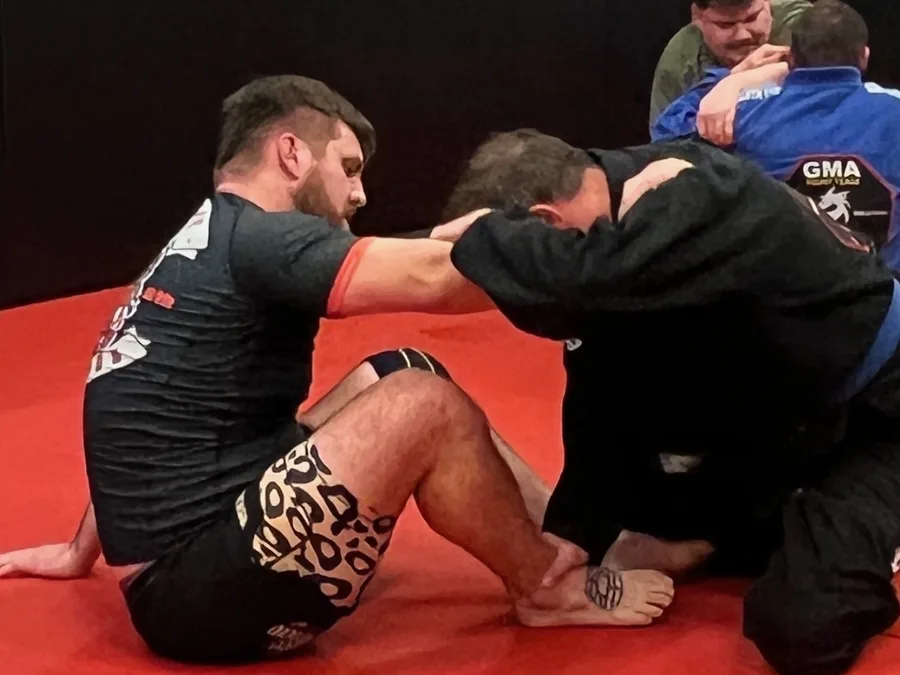
Mount is the classic bad position: your partner sits on your torso with their knees on the mat. The first job is survival. Keep your elbows tight to your ribs, hands near your face and neck, and don't push straight up on their chest with straight arms. That is how people give up an armbar.
Trap and roll (upa)
This is usually the first escape people learn. Trap one of your partner's arms against your chest, then block their foot on the same side with your own foot so they can't post it. Bridge high and turn your shoulder toward the trapped side. With no arm and no foot to catch themselves, they roll over and you end up on top inside their guard. It works best when they lean forward or post a hand on the mat.
Elbow-knee escape
When your partner sits tall and the trap and roll won't work, the elbow-knee escape (also called the shrimp escape) takes over. Turn onto your side, frame on their hip, and shrimp your hips away so your elbow and knee can meet. Slide that knee inside their leg, then repeat on the other side or catch half guard and keep working. Many coaches teach it as a pair with the trap and roll, because a partner who stops one tends to open up the other.
Heel drag
If their weight shifts high toward your head, you can sometimes drag your heel along the mat under their leg and hook into half guard. It is a variation of the same idea: frame, move the hips, and get a leg between you.
Escaping Side Control
In side control your partner lies across your chest from the side, usually with a crossface and an underhook. Their weight is spread out, so a single big bridge rarely lifts them off. Escaping side control is a two-step job: build frames, then use the space.
Frame and shrimp back to guard
Put one forearm across the side of their neck or collarbone and the other hand on their hip. Bridge into them to make them push back, then shrimp away the moment they do. The space opens room for your bottom knee to slide in front of their hips. Once a knee and shin are between you, you can replace your guard. This is the escape you'll use most, and it is built entirely on the bridge and shrimp.
Turning to your knees
If your partner pressures toward your head, you can frame, shrimp a little, then turn away from them, underhook their leg and come up to your knees. From there you can stand, take a single leg, or work back to a neutral scramble. It gives up your guard but gets you out from under the weight.
The underhook and roll-under escapes
When your partner's weight is high, getting your own underhook on their far side lets you come up toward their back. Some escapes also roll underneath your partner, sometimes called the ghost escape. These involve turning your neck and shoulder in a way that should be taught in person, so leave them for class with an instructor watching.
Escaping Back Control
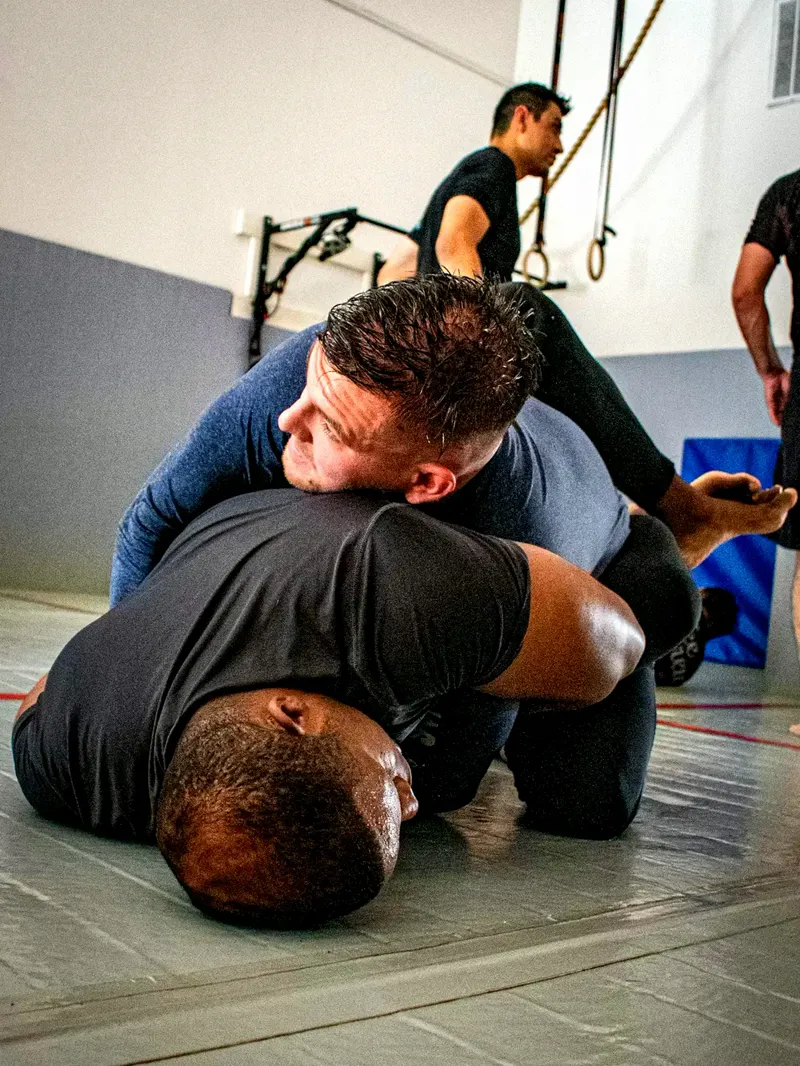
Back control is the most dangerous of the three, because your partner can choke you and you can't see what their hands are doing. The order matters: defend the neck first, then get out.
Fight the hands
Keep your chin down and use both hands to control the arm going around your neck. If you deal with the hooks while their forearm is under your chin, you will run out of time. Two hands on one hand is the rule until the choke is no longer a threat.
Get your shoulders to the mat
Once the neck is safe, slide your hips down so your back and shoulders reach the mat beside your partner instead of sitting on their chest. That takes away much of the angle they need for the choke. Then clear the hook on the side you fell to, using your hand or heel, and turn into them so you end up in their guard or half guard. Which side to fall toward depends on their grips and on whether you are in the gi or no-gi, and coaches teach more than one version. This is one to learn in class with an instructor watching.
Body triangle and seat belt
Some partners lock their legs in a body triangle or hold a seat belt grip (one arm over the shoulder, one under). The principles stay the same: protect the neck, get your shoulders to the mat, and turn in. Against a body triangle, crossing your top leg over their ankles can loosen the lock, but expect it to take patience.
A Quick Reference Table
| Position | Survive first | Escape to learn first |
|---|---|---|
| Mount | Elbows tight, hands near your neck | Trap and roll, then elbow-knee |
| Side control | Frames on the neck and hip | Frame and shrimp back to guard |
| Back control | Chin down, two hands on the choking arm | Shoulders to the mat, clear a hook, turn in |
How to Get Better at BJJ Escapes
Drill the movements alone. The bridge, the shrimp and the technical stand-up do most of the work in every escape above. Our guide to solo jiu jitsu drills shows how to practice them at home.
Use positional sparring. Start in a bad position and have your partner try to hold or submit while you try to escape. Ten short rounds from mount will teach you more than one long roll where you never end up there.
Breathe and be patient. Panic burns energy and makes you push with straight arms. Experienced students often wait under mount for the right moment rather than bridging every second.
Connect escapes to your guard. Most escapes end with you in guard or half guard. Once you are there, our list of BJJ sweeps for every guard shows how to keep going and end up on top.
Get extra reps. Weekday open mat (11:00 AM to 1:00 PM) is a good time to ask a partner to hold you in a bad spot so you can drill escapes at your own pace.
At Rocian Gracie Jr. Jiu-Jitsu at GMA, escapes from mount, side control and back control are part of the adult curriculum, and beginners train in the regular classes from day one. You don't need any experience to start.
Learn to Escape Calmly
Escapes and survival are part of every adult class at GMA in Gallatin, TN. Beginners train from day one, and your first class is free.
Book Your Free ClassFrequently Asked Questions
What is the first BJJ escape a beginner should learn?
Most coaches start with the trap and roll (upa) escape from mount and the frame and shrimp escape from side control. Both teach the bridge and the hip escape, which show up in almost every other escape.
Do escapes score points in BJJ competition?
No. Under IBJJF rules, points go to positions such as mount and back control (4 points each) and guard pass (3 points). Escaping earns nothing by itself, but it stops your opponent from adding more and gets you back into the match.
Which position is hardest to escape?
Many students find back control the hardest, because the choke is a constant threat and you can't see your partner's hands. Always protect your neck before you try to escape.
Why can't I escape when someone is much heavier?
Usually because you are pushing against their full weight. Good escapes use frames to hold space, then move your hips while your partner is shifting. Timing beats strength here, and it improves with drilling.
Where can I learn BJJ escapes in Gallatin, TN?
Escapes and survival are part of the curriculum in our adult Gi Jiu-Jitsu classes. Beginners are welcome, and you can book a free trial class to try one.