Every new student hears the same advice in their first few rolls: "Breathe." It sounds too simple to matter, until you find yourself stuck under side control, holding your breath, arms burning, and gassed after ninety seconds. Learning a few BJJ breathing techniques is one of the fastest ways to last longer, think more clearly and stay calm when someone heavier is on top of you. This guide covers why grapplers hold their breath, what the research on controlled breathing actually shows, and the specific drills we use so you can carry them onto the mat in Gallatin or anywhere else you train.
Nothing here needs special equipment or a lot of time. Most of it is about noticing what your breath is doing and changing it on purpose.
Why Grapplers Hold Their Breath
Breath-holding under pressure is a normal reaction. When you feel trapped, your body shifts toward a fight-or-flight state: heart rate climbs, muscles tense and breathing either stops or turns fast and shallow from the upper chest. In a scramble that lasts two seconds, that reflex is fine. In a six-minute round, it is expensive.
Here is what it costs you on the mat:
- Energy. Bracing every muscle while holding your breath burns through your gas tank long before your conditioning should run out.
- Decision making. Panic narrows your focus. You stop seeing the frame, the hip escape or the underhook that is right in front of you.
- Strength at the wrong moment. Grip and pushing strength fade quickly when you are tense and oxygen-starved, so the escape you finally see comes with nothing left to power it.
The good news is that breathing is the one part of your nervous system you can steer directly. You cannot tell your heart to slow down, but you can lengthen your exhale, and your heart rate tends to follow.
What the Research Says About Controlled Breathing
There is not much research on breathing in jiu-jitsu specifically, so it is worth being honest about what the evidence covers. The studies below look at controlled breathing in general, not at people being crushed under a knee on belly. They are still useful because they show what slow, deliberate breathing does to the body.
Slow breathing and the nervous system
A 2018 systematic review in Frontiers in Human Neuroscience (Zaccaro et al.) looked at studies of slow breathing, defined as fewer than 10 breaths per minute. Across the studies that met its criteria, slow breathing was linked to higher heart rate variability (a marker of a calmer, more flexible nervous system) and to people reporting more relaxation and alertness and less anxiety and anger. The authors noted the evidence base was small, only 15 studies made the cut, and called for more research.
The cyclic sighing study
In 2023, Stanford researchers published a randomized study in Cell Reports Medicine (Balban et al.). 111 healthy adults did five minutes a day of either mindfulness meditation or one of three breathing exercises for a month. The breathing groups improved mood more than the meditation group, and the biggest gain in positive mood came from cyclic sighing: two inhales through the nose followed by a long, slow exhale. All the groups also reported less anxiety. The study left out people with moderate to severe psychiatric conditions, and the authors framed the result as promising rather than final.
Put together, the research supports something coaches have said for decades: slower breathing with a long exhale tends to calm you down. It is not a magic switch, but it is a reliable lever.
BJJ Breathing Techniques You Can Use on the Mat
These are the BJJ breathing techniques we see help students the most. Practice them off the mat first so they are automatic when you are tired.
1. Belly breathing (diaphragmatic breathing)
Most stressed breathing happens high in the chest. Belly breathing moves the work down to the diaphragm, which gives you a fuller breath with less effort. Lie on your back with one hand on your chest and one on your stomach. Breathe in through your nose so the lower hand rises and the upper hand barely moves. This is also the position you will be in on the bottom of a pin, so practicing it there is ideal.
2. The long exhale
When you feel the panic start, make your exhale longer than your inhale. A simple pattern is in for a count of three, out for a count of five or six. You do not need to count perfectly in a roll; just keep pushing the air out slowly instead of in short bursts. If you only remember one thing from this article, remember this one.
3. Cyclic sighing (the double inhale)
This is the pattern from the Stanford study. Breathe in through your nose until your lungs feel comfortably full, take a second short sip of air on top, then let it all out slowly through your mouth. Two or three of these between rounds can bring your heart rate down faster than standing there gasping. It also works well in the minutes before a competition match.
4. Box breathing for between rounds
Box breathing uses four equal counts: in for four, hold for four, out for four, hold for four. It was one of the breathing patterns in the same 2023 study. It is too structured to use in the middle of a scramble, but it is a good way to settle down while you wait for the next round or sit on the edge of the mat after a hard one.
5. Breathing under pressure
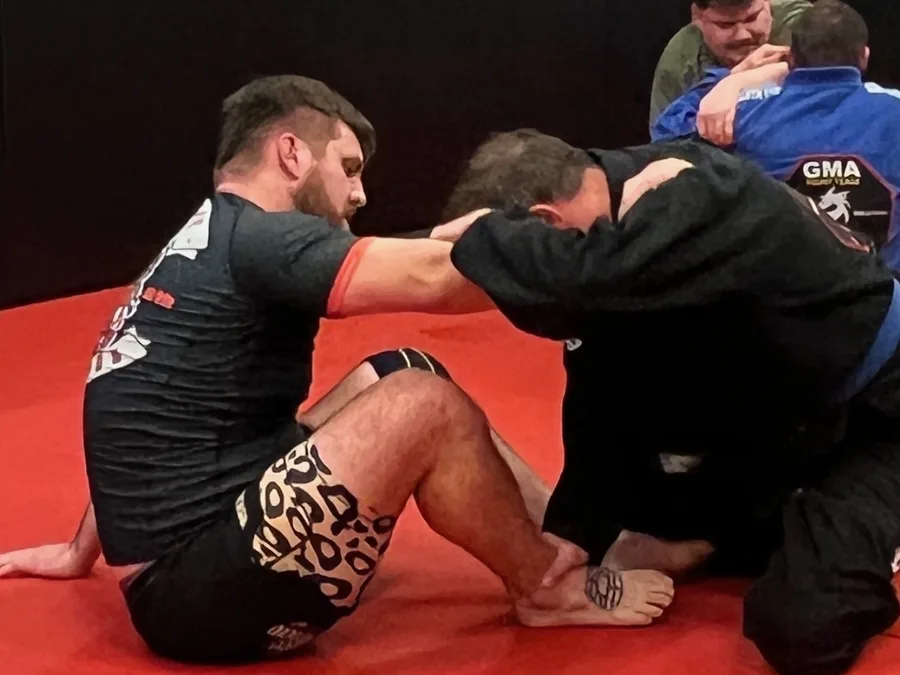
Breathing while someone is on top of you is a skill of its own. A heavy top player will often time pressure to your exhale. Instead of fighting for a big chest breath, take smaller, steady breaths into your belly and sides, and use your frames to create a little space for your ribs. Exhale as you move, the same way you would on a heavy lift. Many students notice their escapes from mount, side control and back get easier once they stop holding their breath before each hip escape.
Drills to Build Better Breathing
Breathing well while tired is trained, not learned from an article. These drills build it over a few weeks.
- Five minutes a day off the mat. Pick belly breathing or cyclic sighing and do it for five minutes, the same dose used in the Stanford study. Before bed or in the car before class both work.
- Nose-only drilling. During warm-ups and technique drilling, try to breathe only through your nose. If you cannot, you are going harder than the drill needs.
- Bottom-position rounds. Ask a training partner to hold side control or mount with moderate pressure for 60 seconds while you do nothing but breathe calmly and frame. Then add escapes. Positional sparring like this is part of our adult Gi jiu-jitsu classes.
- Breath check every round. Pick a cue, such as each time you reset to the knees, and ask yourself: am I holding my breath? This habit alone fixes a lot.
- Long exhales during conditioning. Strength and conditioning work is a good place to practice exhaling on effort. Our guide to strength training for jiu jitsu covers a simple two-day program.
Breathing, Pace and Staying Calm in a Roll
Breathing and pace feed each other. If you go 100 percent from the slap of hands, your breathing falls apart and you spend the rest of the round surviving. Experienced students pick their moments: they breathe and recover in stable positions, then burst when they see a real opening. Watch an upper belt roll and you will notice how often they seem to be resting, even on the bottom.
A few rules of thumb for live rolling:
- Settle your breath in the first 15 seconds before you start working.
- Breathe out as you explode into a sweep, pass or escape, not in.
- When you reach a good position, take two slow breaths before attacking.
- If you feel panic, focus on the exhale first and the technique second.
Breathing is also a big part of why so many people find training calming. We cover more of that in our post on jiu-jitsu and mental health.
A Note on Safety
Breathing calmly does not mean waiting out a submission. If a choke is locked in, tap early; no breathing technique gets you out of a properly applied strangle. Learn chokes, escapes and pressure under a qualified coach, and train with partners who let go when you tap. Breath-hold training and hyperventilation methods sometimes shared online carry real risks, including passing out, and do not belong on the mat or in the water. If you have asthma, a heart condition, or you get dizzy or short of breath during training, talk to your doctor before trying new breathing routines.
The fastest way to build these habits is to practice them in real rolls with a coach watching. At Rocian Gracie Jr. Jiu-Jitsu at GMA in Gallatin, TN, beginners train with everyone from their first class with an instructor guiding them, and your first class is free. Book a free trial class and bring your breathing with you.
Learn To Breathe Under Pressure
No experience or fitness needed. Try a free adult jiu-jitsu class in Gallatin, TN and practice staying calm with a coach watching.
Book Your Free ClassFrequently Asked Questions
How do you breathe while rolling in BJJ?
Breathe through your nose when you can, keep breaths low in your belly, and make your exhale longer than your inhale. Exhale as you explode into a movement, and never hold your breath to brace for a whole exchange.
Why do I gas out so fast in jiu-jitsu?
Most beginners gas out from tension and breath-holding, not poor fitness. Bracing every muscle and holding your breath burns energy fast. Relaxing, pacing yourself and breathing steadily usually help more in the first months than extra cardio.
What is the best breathing exercise for calming down between rounds?
Cyclic sighing works well: a full inhale through the nose, a second short sip on top, then a long slow exhale through the mouth. A 2023 Stanford study found five minutes a day of it improved mood more than mindfulness meditation.
How do I breathe when someone is on top of me?
Take smaller, steady breaths into your belly and sides instead of fighting for one big chest breath, and use your frames to make space for your ribs. Practicing bottom positions in class, like in our adult Gi classes, makes this much easier.
Can breathing techniques help me escape a choke?
No. Calm breathing helps you think clearly earlier in a position, but once a choke is locked in, tap. Learn submissions and defenses under a qualified coach and tap early.