Every MMA fight starts on the feet, but a big share of them get decided on the mat. That is why so many people who watch the UFC end up asking about Brazilian Jiu-Jitsu, and why "BJJ MMA" is such a common search. The short answer: BJJ is the ground game of mixed martial arts. It teaches you how to control a fight once it hits the floor, how to stay safe from your back, and how to finish with a choke or joint lock.
This guide covers where BJJ came into MMA, what changes when punches are allowed, which jiu-jitsu skills carry straight into the cage, and how to train for it. We teach Brazilian Jiu-Jitsu at GMA in Gallatin, TN, and our No-Gi Grappling classes are the format closest to what you see in an MMA fight.
The BJJ MMA Connection: How Grappling Proved Itself
Mixed martial arts is not one style. It is a ruleset that lets different styles meet. Broadly, a fighter has to handle three phases: striking (boxing, kickboxing, Muay Thai, kicking arts), the clinch and takedowns (wrestling and judo), and ground fighting, which is where Brazilian Jiu-Jitsu lives.
The modern sport traces back to UFC 1, held in Denver in November 1993. It was a one-night, eight-man tournament with no weight classes, no judges and no rounds. Fights ended by knockout, submission or a corner throwing in the towel. Jiu-jitsu stood out in those early events because smaller grapplers kept submitting bigger strikers, often with chokes. That changed how the whole martial arts world thought about fighting, and Brazilian Jiu-Jitsu went from a niche Brazilian system to required study for anyone who wanted to compete.
The sport has changed a lot since then. The Unified Rules of Mixed Martial Arts, first agreed by the New Jersey State Athletic Control Board in 2001 and adopted by the Association of Boxing Commissions in 2009, brought five-minute rounds, 4 to 6 ounce gloves, judges, and a list of fouls. Today you rarely see a pure specialist win. Every serious fighter wrestles, strikes and grapples. But the reason every gym teaches jiu-jitsu is the same reason it stood out in 1993: if you cannot defend yourself on the ground, you have a hole in your game that someone will find.
What Changes When Strikes Are Allowed
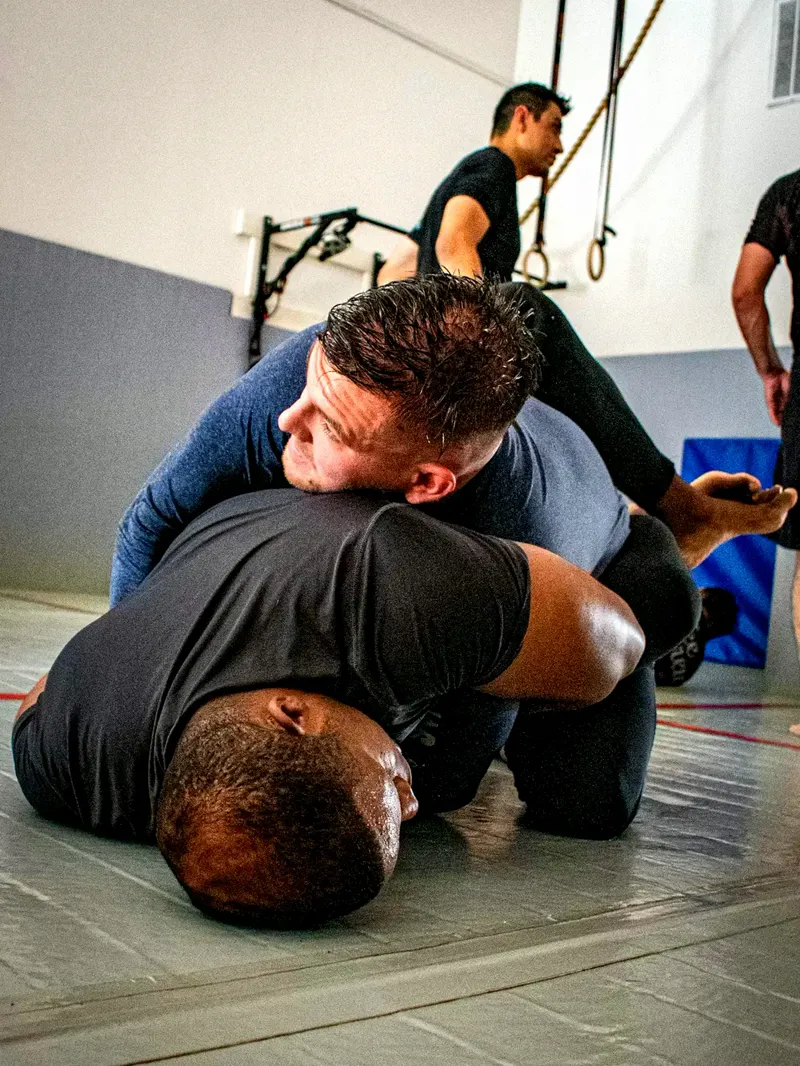
Sport jiu-jitsu and MMA grappling share the same positions, but strikes change the priorities. A few of the biggest differences:
- Distance matters more. In a jiu-jitsu match, you can sit to guard and play from your back all day. In MMA, the person on top can punch. Fighters learn to either hold their opponent tight so they cannot generate power, or create real space with frames and get back up.
- Top position is worth more. Mount and back control were always strong in BJJ. With strikes allowed, they become the positions where fights end, either by submission or by a referee stopping the fight.
- No gi means no grips. MMA fighters wear shorts and 4 to 6 ounce gloves. Collar chokes and sleeve grips are gone. Control comes from underhooks, overhooks, head position and wrist control, which is exactly what No-Gi trains.
- The cage is a tool. Fighters use the fence to hold opponents down or to walk their back up it and stand. Pure grappling mats have no wall, so this is a skill MMA adds on top of jiu-jitsu.
- Some techniques are fouls. The Unified Rules ban small joint manipulation (bending individual fingers and toes), spiking an opponent on the head, strikes to the back of the head, eye gouging, fish-hooking and hair pulling. Most of the jiu-jitsu submission arsenal is legal, though.
None of that makes jiu-jitsu less useful. It changes which parts you lean on. A fighter who knows BJJ well can recognize danger earlier, stay calm from bad positions, and threaten submissions that make opponents hesitate to follow them to the floor.
BJJ Skills That Carry Straight Into the Cage
Escapes and getting back up
Before anything fancy, the most valuable jiu-jitsu skill in MMA is not staying stuck. Bridging out of mount, shrimping to recover guard from side control, and standing up safely from the ground (the technical stand-up) all come from day one of a jiu-jitsu curriculum. They are also some of the best drills you can do on your own; our guide to solo jiu-jitsu drills covers several of them.
Closed guard and posture control
From the bottom, an MMA fighter wants to break the opponent's posture, pull them close, and either tie them up or set up a sweep or submission. Closed guard is still one of the most effective places to do that, as long as you keep the person on top bent over and unable to load up a punch.
Back control
Taking the back gives you the strongest attacking position in grappling, and in MMA the person on the bottom cannot hit you back. Seatbelt grip, hooks or a body triangle, and hand fighting to get the choke are core jiu-jitsu skills.
Submissions that work without a gi
The rear-naked choke, guillotine, arm-triangle, triangle choke, d'arce, kimura and armbar all show up regularly in MMA. All of them work without grabbing fabric. If you want the breakdown of how these chokes work, see our guide to the types of chokes in BJJ. As with any submission, learn them under a qualified coach and tap early in training.
Gi or No-Gi for MMA?
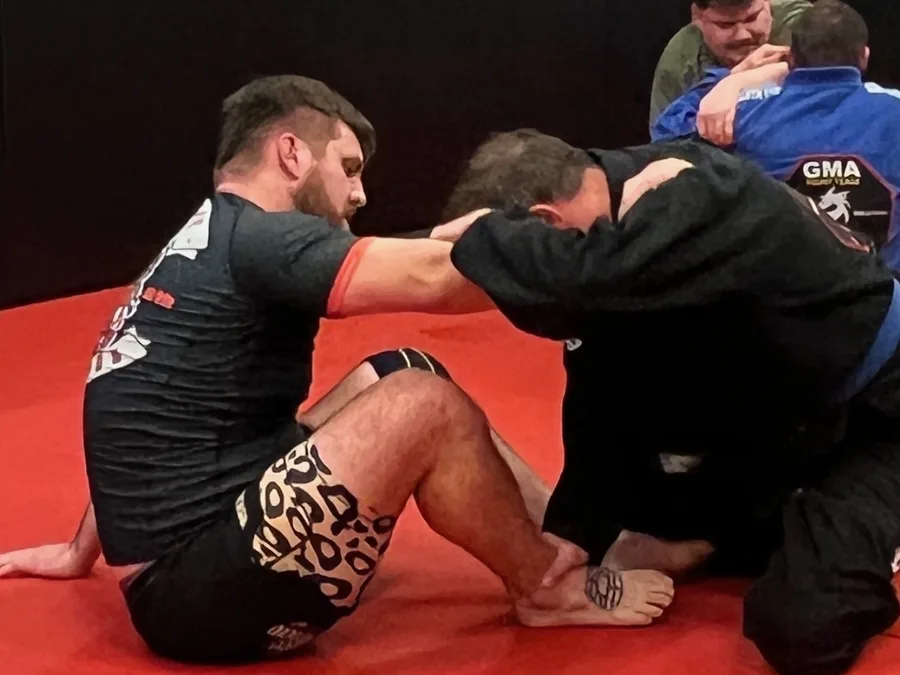
No-Gi grappling is the closer match. Training in a rash guard and shorts forces you to control people with your body instead of their clothing, the pace is faster, and the scrambles look more like what happens in a cage. Wrestling-style takedowns, clinch work and front headlock attacks like the guillotine and d'arce get more attention in No-Gi classes.
That does not make the gi a waste of time. Training in the gi slows the game down and makes escapes harder, because your partner can hold onto you. Plenty of coaches see gi training as the place to build patience, precise technique and defensive habits. Most of our students train both, and both are included in every GMA membership at no extra cost.
A simple way to think about it:
| Goal | Best fit | Why |
|---|---|---|
| Grappling for MMA | No-Gi | No grips, faster pace, more wrestling and clinch |
| Strong technical base | Gi | Slower, more precise, harder escapes |
| Self-defense | Both | Real situations rarely involve a gi, but grip fighting carries over to jackets and clothing |
| Competing in jiu-jitsu | Your choice | IBJJF and other events run both gi and no-gi divisions |
How to Train BJJ If MMA Is Your Goal
If you want to fight one day, or you just want to train like a mixed martial artist, here is a realistic path.
- Start with one base. Most people progress faster by building one art first instead of four at once. Jiu-jitsu is a strong first choice because it teaches you to stay safe and calm when someone heavier is on top of you.
- Train consistently. Two to three classes a week is enough to build real skill while you recover. Live rolling at the end of class is where the technique starts to work against resistance.
- Add striking later, in a separate class. Once your grappling base feels steady, add a striking art. Our sister school, Global Martial Arts USA, teaches TaeKwonDo, HapKiDo and Wing Chun in the same building, and their guide to MMA training for beginners walks through how the pieces fit together.
- Build the engine. MMA rounds are five minutes long, and a three-round fight with grappling exchanges is brutal on your conditioning. Strength work two days a week helps you hold position and finish takedowns.
- Be honest about goals. You do not need to fight to train like a fighter. Most people who train BJJ for its MMA value never step into a cage, and that is a perfectly good reason to train.
Training Jiu-Jitsu for MMA in Gallatin
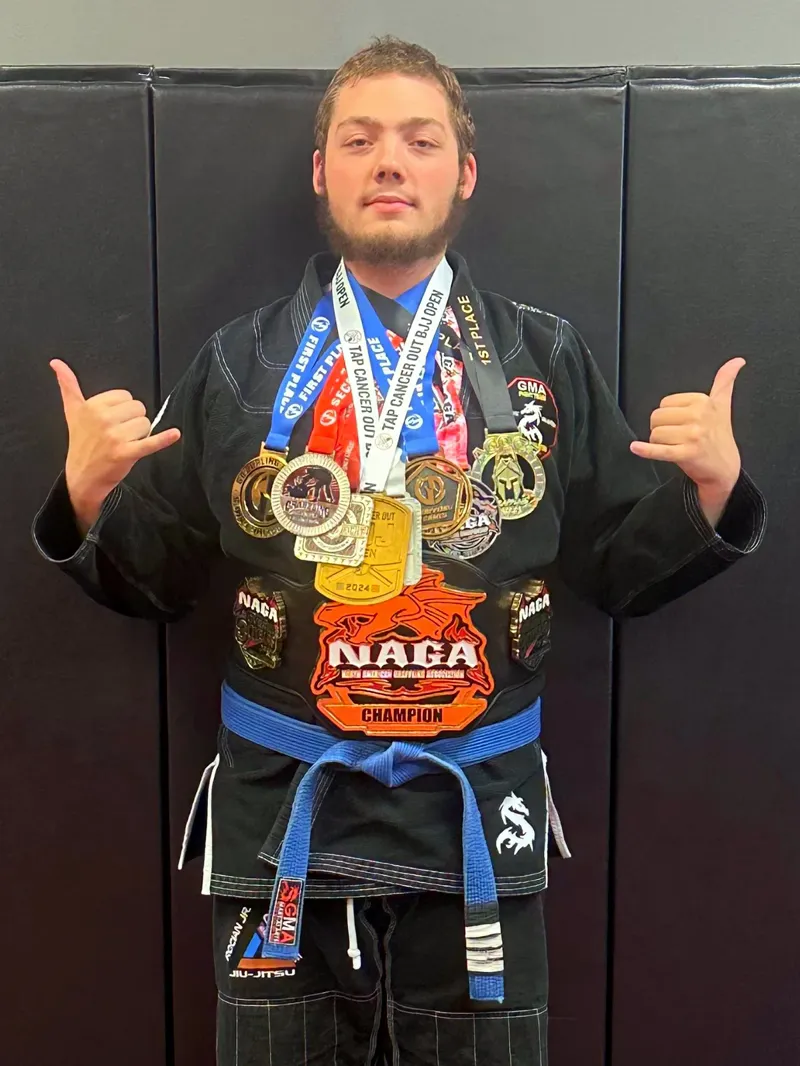
At GMA we teach the Rocian Gracie Jr. Method. Professor Konrado received his black belt directly from Master Rocian Gracie Jr. on December 12, 2000, the first black belt Rocian ever awarded, and has spent more than 50 years in martial arts. Along the way he has worked with UFC and professional fighters and trained law enforcement and military units in hand-to-hand combat, so the self-defense and fighting side of jiu-jitsu is part of how we teach, not an afterthought.
For anyone in Gallatin or Sumner County with MMA on their mind, here is where to start:
- No-Gi Grappling: Open Grappling runs Monday and Wednesday evenings at 7:00 PM for adults and teens 14 and up. Takedowns, clinch control, submission chains and scrambles.
- Adult Gi Jiu-Jitsu: the technical foundation, four evenings a week.
- Fight Team: competition training by invitation once you have a solid foundation. Competing is never required.
You do not need any experience, and you do not need to be in shape before you start. Your first class is free. Book a free trial class, come in 10 minutes early, and we will help you figure out the right mix of Gi and No-Gi for what you want out of training.
Train the Ground Game
Try a free No-Gi or Gi Brazilian Jiu-Jitsu class in Gallatin, TN. No experience needed, and fighters from any striking background are welcome.
Book Your Free ClassFrequently Asked Questions
Is BJJ good for MMA?
Yes. Brazilian Jiu-Jitsu is the ground game of mixed martial arts. It teaches you to escape bad positions, control an opponent on the mat and finish with submissions, and nearly every MMA fighter trains it.
Should I train Gi or No-Gi for MMA?
No-Gi is the closer match because MMA fighters can't grip clothing. Gi training still builds precise technique and strong defense, and many students train both. At GMA both are included in every membership; see No-Gi Grappling.
Can I learn MMA-style grappling with no experience?
Yes. Most people who start at GMA have never trained. Classes start with a warm-up and basic technique, and you can sit out live rounds until you're ready. Your first class is a free trial.
Do I have to fight or compete to train BJJ for MMA?
No. Most people who train jiu-jitsu for its MMA value never compete. Competition through our Fight Team is optional and by invitation.
Are leg locks allowed in MMA?
Leg locks like kneebars, ankle locks and heel hooks are generally legal in MMA. The Unified Rules ban small joint manipulation, which means attacking individual fingers or toes. At GMA, leg entanglements are introduced progressively once you have the control to train them safely.